

Automatic Voice Leading
Voice leading determines how notes move from one chord to the next, minimizing large jumps and keeping common and melodic tones in place.
Without voice leading, every chord is voiced in root position — all notes jump to the new chord’s default shape. With voice leading, chord notes are arranged in such a way to produce smoother, more musical transitions.
Enabling voice leading
Section titled “Enabling voice leading”
Toggle the Auto Voice Leading (AVL) checkbox in the lower controls row. When enabled, chords after the first chord in the progression are automatically re-voiced for smooth movement using an algorithm that considers the overall register of the progression as well as the voicing style of the first and any subsequent non-managed chords.
The sub-option Bass Inversions appears only when AVL is enabled and determines whether the voice leading algorithm is allowed to use inversions that change the bass note of a chord. This can lead to smoother voice leading especially for more constricted voicing styles like Closed, but may not always be desirable depending on the harmonic complexity and style of the progression; hence the optional toggle. Chords with inverted bass are denoted in slash notation, e.g. “Cmaj7/E”.
Managed chord blocks
Section titled “Managed chord blocks”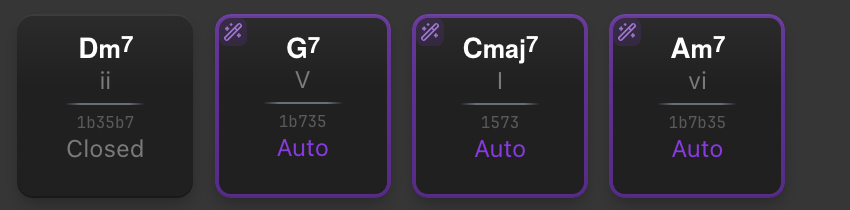
When AVL is enabled, each chord modified by it is shown with a purple frame and has its chosen voicing style set to Auto to indicate that its voicing is managed by the algorithm. You can override the automatic management for a chord by picking a different voicing style for it, which then removes the purple border and turns it into a non-managed chord. To allow the chord to be automatically managed again, open the Voicing Picker once more and choose the option Auto. Note that this option only appears if AVL is enabled.
Full Lock protects a chord’s identity and length from replacement, but it does not freeze the voicing. If Automatic Voice Leading is enabled, locked chords can still participate in the voice-leading pass so transitions remain smooth.